


Bonipak Produce opened its doors to the Central Coast as part of the 7th annual Santa Barbara County Farm Day on Saturday, Sept. 6. The countywide event featured 23 farms across Santa Barbara County, from Santa Maria to Carpinteria. Bonipak Produce, located in the agricultural oasis of the Santa Maria Valley, has been serving the Central Coast for more than 90 years.
Employees lined the front of the farm with educational booths to teach families, students, and other community members about the latest advancements in agriculture.
Joseph Frost, Bonipak Produce’s Supervisor of Automation, stood before some of the farm’s latest AI-powered automotive tools. To his left was an iPad-controlled planter driven by AI.
“We’re not afraid of using serial No. 1s here,” Frost said, meaning Bonipak uses the first available iteration of a product to stay on the cutting edge.
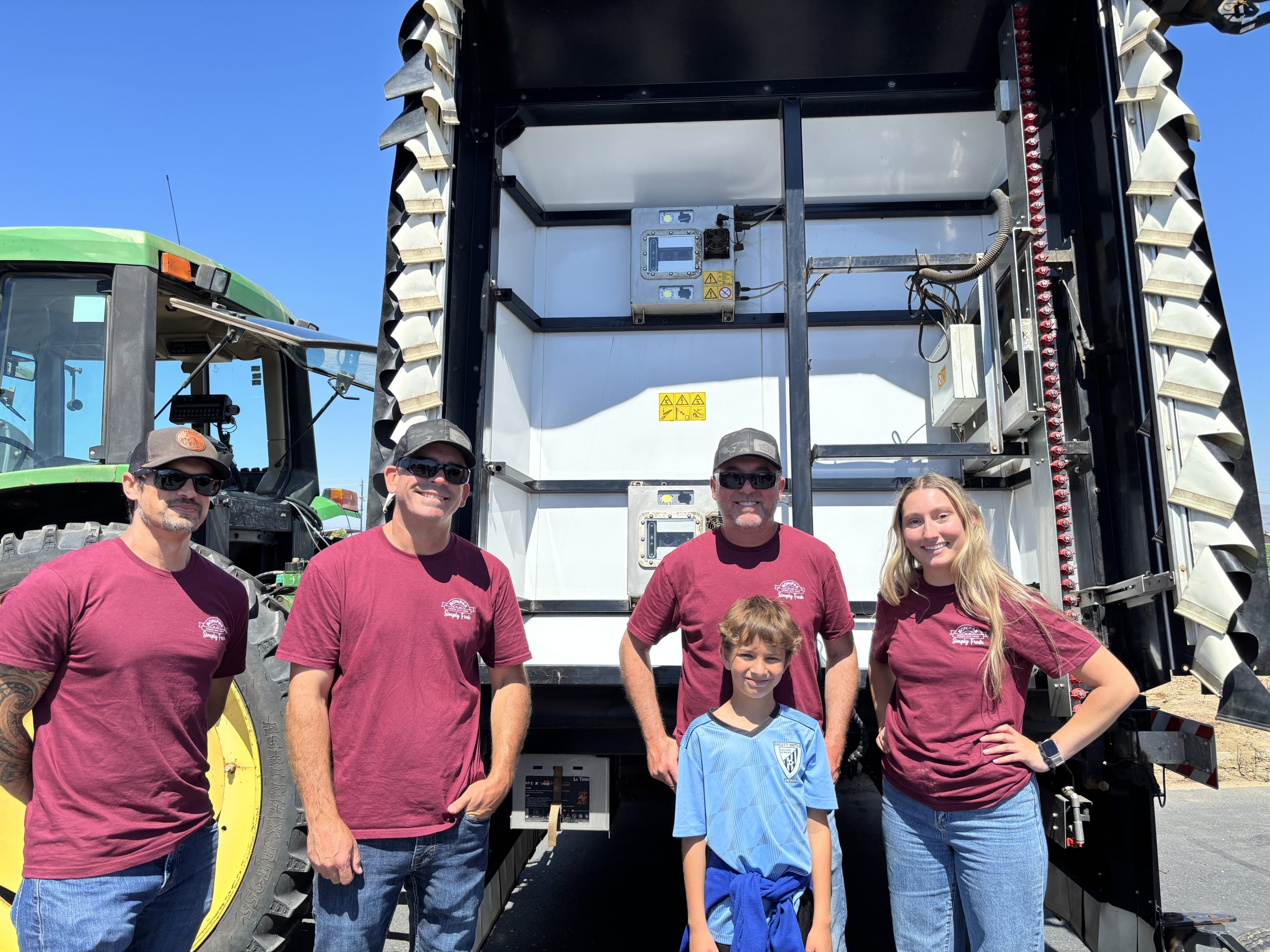
The person operating the planter can use the iPad to access live data from the sensors, including seed dispersal locations, or to adjust seeding rates. Frost said that Bonipak is eager to try new technological tools, even if they’re the first to come off the production line.
Adjacent to the display was an AI-powered precision crop sprayer developed by Swiss company Ecorobotix. Another serial No. 1, Frost said that Bonipak has been using this technology for two years.
Frost explained that Bonipak utilizes a weed identification tool driven by an AI algorithm trained on a database of weed imagery. Developed by an agricultural research institute in New Zealand, the technology, called Map and Zap, has been used at Bonipak for a year.

Because of its location and presence in the agricultural industry, job opportunities at Bonipak Produce attract many Cal Poly students and alumni. Lizbeth Juarez, pictured above, earned a degree in plant science from Cal Poly in June.
Currently an intern at Bonipak’s parent company, Betteravia Farms, Juarez spends her days testing tissue and water levels in the soil. At Bonipak’s soil science booth, she displayed a pamphlet explaining nematode diseases that affect food and fiber crops, along with other scientific literature for attendees to browse.
Standing under a dark green tent displaying the words “Cal Poly College of Agriculture, Food, and Environmental Sciences” were Shaelyn Spencer and Sophie Rodriguez, senior plant science majors and CAFES ambassadors.
“We make sure that [CAFES’] name is still out there, we reconnect with the community, and just be a part of it,” said Spencer, the executive ambassador for CAFES. “I feel like they give so much to us, buying [Cal Poly’s] produce, purchasing our cheeses, and I think it’s just great to get out and meet the people who truly support us.”


Rodriguez, president of Cal Poly’s chapter of the horticultural honors society Pi Alpha Xi, expressed her love for Cal Poly and her passion for volunteer work.
“I know this is the school I was destined to go to,” Rodriguez said. “I’m always happy to come and advocate for it and volunteer.”
Nearby, members of the California Farmworker Foundation, including President and Founder Joe Garcia, boothed alongside Cal Poly students and other local organizations.

Founded nine years ago, the foundation addresses unmet needs in a community with large populations of both immigrants and agricultural workers.
“We have a trusted partnership with growers and farm workers. We’re here to improve the farm workers’ lives […], not to create labor strife or make false promises,” Garcia said.
The foundation offers resources like immigration help, healthcare, workforce training, and Spanish classes for Indigenous people in the community.
The foundation reached out to 800 to 1000 farm workers in the area and did six months of surveys before implementing their programs.
According to Garcia, the foundation restructured its financing and budgets this year due to a loss of government funding and a downturn in California’s agricultural economy, which was exacerbated by the wine industry’s oversupply.

“People are cutting a lot of jobs or selling their farms. There’s a lot of variables in all that, of course, so we’re going through the same thing as everybody in the country,” Garcia said.
Employees from different parts of the supply chain participated in Bonipak’s open house and tours, located behind the booths in the packaging facility. Anthony Cochiolo, a third-generation truck driver, has been driving for Bonipak for the past five years.
“I first started riding in trucks when I was in a car seat,” Cochiolo cheerfully told a group of Future Farmers of America members, families, and community members during a tour. His son is now in school to become a trucker, carrying on his family’s legacy.
Farmers and families alike browsed this unique display of the Central Coast’s agricultural industry, bringing together university students, curious residents, and generational cultivators to pull back the curtain and explore the world of local food producers.
